Baby’s Brain Begins Now: Conception to Age 3
Thanks to recent advances in technology, we have a clearer understanding of how these effects are related to early brain development. Neuroscientists can now identify patterns in brain activity that appear to be associated with some types of negative early experiences.1
But the long-term effects of early stress, poverty, neglect and maltreatment were well documented and virtually uncontested years before we could “see” them with brain scanning tools. So why should we need an understanding of brain development to show us how important children’s earliest experiences are for their well-being? Isn’t neuroscience just telling us what we already know?
Actually, there are several reasons why we should pay attention to the evidence provided by neuroscience. For instance, it may help us learn exactly how experiences affect children. This knowledge can aid our efforts to help children who are at risk and to undo, where possible, the effects of early adversity. Additionally, neuroscientists may help us learn when experiences affect children. If there are specific periods of vulnerability to certain types of experiences, then understanding these patterns will improve our attempts at intervention.
So far, neuroscience has not found conclusive answers to these questions. However, dramatic advances continue to be made in the field, and brain research continues to enhance education and intervention efforts. Accordingly, we have expanded this year’s Brain Development chapter to include additional information reflecting the latest scientific research.
We begin with a thumbnail sketch of brain anatomy, followed by a closer look at neurons and synapses, the brain’s communication specialists. We then discuss some unique features of early brain development and show how they make the first three years of life an especially critical period. Finally, we present an outline of brain development from conception to three, linking developmental events to the cognitive and behavioral changes associated with them.
An Overview of Brain Anatomy
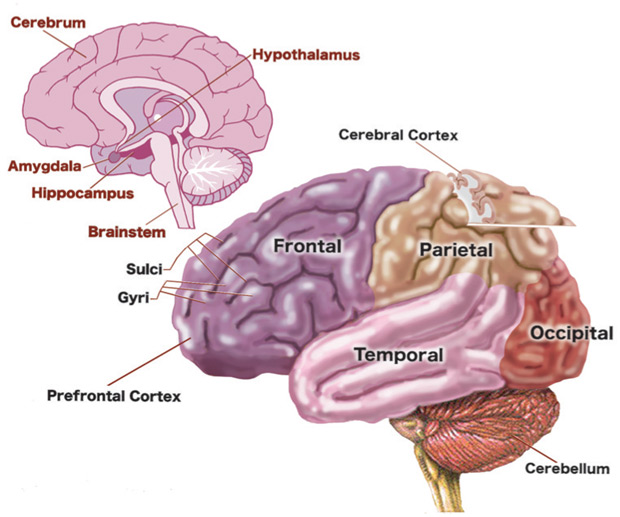
The easiest way to get to know the brain is to learn the main structures of the adult brain and how they relate to its function (Figure 1). It should be kept in mind that the relationship between brain structure and function is never simple. Although we often hear claims about the “language area” or “emotion center” of the brain, statements like these are simplifications; in reality, even the simplest mental activities involve multiple brain regions.
The brain can be divided into three major parts. The brain stem, shaped like a widening stalk, connects the spinal cord to the upper brain. It controls reflexes and involuntary processes like breathing and heart rate. Behind the brain stem and below the upper brain is the cerebellum, which is involved in balance and coordination.
The cerebrum, the largest part of the brain, sits above the brain stem and cerebellum. While each of the brain’s structures plays an essential role, the cerebrum is the area most involved in higher processes like memory and learning. The cerebrum’s outer surface is called the cerebral cortex. Although less than one-fourth of an inch thick (in adulthood), it is where the brain’s most advanced activities – such as planning and decision-making – take place.
The folds of the cerebral cortex, which give the brain its wrinkled appearance, are an important feature of the brain’s structure. Appearing during prenatal development, these folds increase the surface area of the cerebral cortex and allow more of it to be “packed” inside the skull. The resulting ridges and grooves form a pattern that is essentially the same from person to person. The ridges are called gyri (singular=gyrus); the grooves are called sulci (singular=sulcus).
Source: Adapted by Bill Day from www.educarer.org, 2006.
Scientists use gyri and sulci to divide the cerebral cortex into smaller units called lobes. Each hemisphere has four lobes. The occipital lobes, at the back of the brain, control vision. The parietal lobes are associated with bodily sensations like heat, cold, pressure, and pain. The temporal lobes are involved with hearing, language skills, and social understanding, including perception of other people’s eyes and faces. The frontal lobes are associated with memory, abstract thinking, planning, and impulse control. The forward-most section of the frontal lobes is a distinct area referred to as the prefrontal cortex. This is the last brain area to mature, undergoing important developmental changes as late as adolescence. The prefrontal cortex is the location of our most advanced cognitive functions, including attention, motivation, and goal-directed behavior.2-4
Although our advanced cognitive abilities are dependent on the cerebral cortex, it is not the only part of the brain relevant to child development. The limbic system, located in the inner brain beneath the cortex, is a collection of small structures involved in more instinctive behaviors like emotional reactions, stress responses, and reward-seeking behaviors. The hippocampus is involved in memory formation and spatial learning. The hypothalamus is the control center for one of the body’s key stress systems, regulating the release of cortisol and other stress hormones. The amygdala evaluates threats and triggers the body’s stress response.2,5,6
Neurons and synapses form the wiring of the brain.
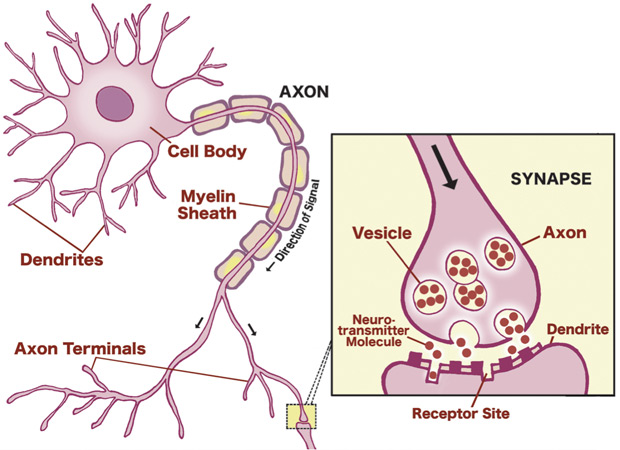
The brain processes information by forming networks of specialized nerve cells, called neurons, which communicate with one another using electrical and chemical signals (Figure 2). These messages are the physical basis of learning and memory.7 A neuron consists of a cell body and the branch-like structures that extend from it. These include multiple dendrites and an axon, which may have numerous axon terminals. The cell body is the neuron’s control center; among other duties, it stores DNA and generates energy used by the cell. The dendrites receive incoming signals from other neurons, and the axon and its terminal branches relay outgoing signals to other neurons. Axons are sometimes coated with myelin, a fatty substance that insulates the axon and increases the efficiency of communication.
Messages are passed between neurons at connections called synapses. The neurons do not actually touch, however. There is a microscopic gap – the synaptic cleft – between the axon terminal of one neuron and the dendrite of another. Communication between neurons involves complex electrical and chemical processes, but its basics can be outlined simply:
When a neuron (let’s call it Neuron A) receives a chemical signal from another neuron, Neuron A becomes electrically charged in relation to the surrounding fluid outside its membrane. This charge travels down its axon, away from the cell body, until it reaches the axon’s end. Waiting here inside the axon terminals are a group of storage sites, called vesicles, that contain chemicals manufactured and delivered by the cell body. When the electrical charge arrives at the axon terminal, it causes these vesicles to fuse with the terminal’s cell membrane, spilling their contents out of the cell and into the synaptic cleft.
As Neuron A returns to its resting state, the molecules it spilled – called neurotransmitters – make their way across the synaptic cleft to Neuron B’s dendrite. When they arrive, they bind with receptor sites in the dendrite’s membrane. Each time a neurotransmitter molecule from Neuron A binds with a receptor on Neuron B, ions from the fluid surrounding the cells enter Neuron B through the unlocked receptor. As a result, Neuron B develops an electrical charge, the charge travels down its axon, and the process continues.2
Source: Adapted by Bill Day from www.educarer.org, 2006.
In the first three years, a child’s brain has up to twice as many synapses as it will have in adulthood.
Now that we’re a little more familiar with the fundamentals of the brain, let’s take a look at brain development in children. Between conception and age three, a child’s brain undergoes an impressive amount of change. At birth, it already has about all of the neurons it will ever have. It doubles in size in the first year, and by age three it has reached 80 percent of its adult volume.8-10
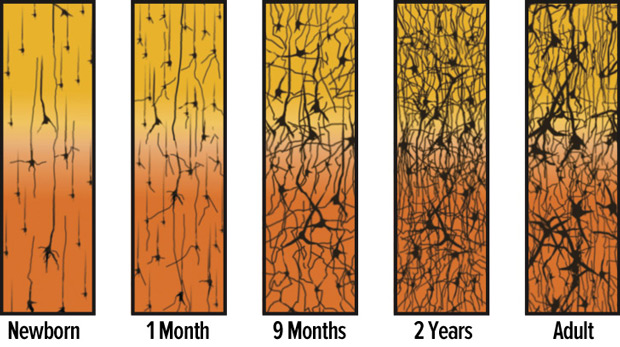
Even more importantly, synapses are formed at a faster rate during these years than at any other time. In fact, the brain creates many more of them than it needs: at age two or three, the brain has up to twice as many synapses as it will have in adulthood (Figure 3). These surplus connections are gradually eliminated throughout childhood and adolescence, a process sometimes referred to as blooming and pruning.11
Source: Adapted from Corel, JL. The postnatal development of the human cerebral cortex. Cambridge, MA: Harvard University Press; 1975.
The organization of a child’s brain is affected by early experiences.
Why would the brain create more synapses than it needs, only to discard the extras? The answer lies in the interplay of genetic and environmental factors in brain development.
The early stages of development are strongly affected by genetic factors; for example, genes direct newly formed neurons to their correct locations in the brain and play a role in how they interact.12,13 However, although they arrange the basic wiring of the brain, genes do not design the brain completely.14,15
Instead, genes allow the brain to fine-tune itself according to the input it receives from the environment. A child’s senses report to the brain about her environment and experiences, and this input stimulates neural activity. Speech sounds, for example, stimulate activity in language-related brain regions. If the amount of input increases (if more speech is heard) synapses between neurons in that area will be activated more often.
Repeated use strengthens a synapse. Synapses that are rarely used remain weak and are more likely to be eliminated in the pruning process. Synapse strength contributes to the connectivity and efficiency of the networks that support learning, memory, and other cognitive abilities.16,17 Therefore, a child’s experiences not only determine what information enters her brain, but also influence how her brain processes information.
Genes provide a blueprint for the brain, but a child’s environment and experiences carry out the construction.
The excess of synapses produced by a child’s brain in the first three years makes the brain especially responsive to external input. During this period, the brain can “capture” experience more efficiently than it will be able to later, when the pruning of synapses is underway.11 The brain’s ability to shape itself – called plasticity – lets humans adapt more readily and more quickly than we could if genes alone determined our wiring.18 The process of blooming and pruning, far from being wasteful, is actually an efficient way for the brain to achieve optimal development.
From Conception to Age Three: An Outline of Early Brain Development
First Trimester
The development of the brain begins in the first few weeks after conception. Most of the structural features of the brain appear during the embryonic period (about the first 8 weeks after fertilization); these structures then continue to grow and develop during the fetal period (the remainder of gestation).19,20
The first key event of brain development is the formation of the neural tube. About two weeks after conception, the neural plate, a layer of specialized cells in the embryo, begins to slowly fold over onto itself, eventually forming a tube-shaped structure. The tube gradually closes as the edges of the plate fuse together; this process is usually complete by four weeks after conception. The neural tube continues to change, eventually becoming the brain and spinal cord.20,21
About seven weeks after conception the first neurons and synapses begin to develop in the spinal cord. These early neural connections allow the fetus to make its first movements, which can be detected by ultrasound and MRI even though in most cases the mother cannot feel them. These movements, in turn, provide the brain with sensory input that spurs on its development. More coordinated movements develop over the next several weeks.22
Second Trimester
Early in the second trimester, gyri and sulci begin to appear on the brain’s surface; by the end of this trimester, this process is almost complete. The cerebral cortex is growing in thickness and complexity and synapse formation in this area is beginning.20,21,23
Myelin begins to appear on the axons of some neurons during the second trimester. This process – called myelination – continues through adolescence. Myelination allows for faster processing of information: for the brain to achieve the same level of efficiency without myelination, the spinal cord would have to be three yards in diameter.14
Third Trimester
The early weeks of the third trimester are a transitional period during which the cerebral cortex begins to assume many duties formerly carried out by the more primitive brainstem. For example, reflexes such as fetal breathing and responses to external stimuli become more regular. The cerebral cortex also supports early learning which develops around this time.24,25
Year One
The remarkable abilities of newborn babies highlight the extent of prenatal brain development. Newborns can recognize human faces, which they prefer over other objects, and can even discriminate between happy and sad expressions. At birth, a baby knows her mother’s voice and may be able to recognize the sounds of stories her mother read to her while she was still in the womb.26,27
The brain continues to develop at an amazing rate throughout the first year. The cerebellum triples in size, which appears to be related to the rapid development of motor skills that occurs during this period. As the visual areas of the cortex grow, the infant’s initially dim and limited sight develops into full binocular vision.28,29
At about three months, an infant’s power of recognition improves dramatically; this coincides with significant growth in the hippocampus, the limbic structure related to recognition memory. Language circuits in the frontal and temporal lobes become consolidated in the first year, influenced strongly by the language an infant hears. For the first few months, a baby in an English-speaking home can distinguish between the sounds of a foreign language. She loses this ability by the end of her first year: the language she hears at home has wired her brain for English.30,31
Year Two
This year’s most dramatic changes involve the brain’s language areas, which are developing more synapses and becoming more interconnected. These changes correspond to the sudden spike in children’s language abilities – sometimes called the vocabulary explosion – that typically occurs during this period. Often a child’s vocabulary will quadruple between his first and second birthday.
During the second year, there is a major increase in the rate of myelination, which helps the brain perform more complex tasks. Higher-order cognitive abilities like self-awareness are developing: an infant is now more aware of his own emotions and intentions. When he sees his reflection in a mirror, he now fully recognizes that it is his own. Soon he will begin using his own name as well as personal pronouns like “I” and “me.”14,28
Year Three
Synaptic density in the prefrontal cortex probably reaches its peak during the third year, up to 200 percent of its adult level. This region also continues to create and strengthen networks with other areas. As a result, complex cognitive abilities are being improved and consolidated. At this stage, for example, children are better able to use the past to interpret present events. They also have more cognitive flexibility and a better understanding of cause and effect.14,32
The earliest messages that the brain receives have an enormous impact.
Early brain development is the foundation of human adaptability and resilience, but these qualities come at a price. Because experiences have such a great potential to affect brain development, children are especially vulnerable to persistent negative influences during this period. On the other hand, these early years are a window of opportunity for parents, caregivers, and communities: positive early experiences have a huge effect on children’s chances for achievement, success, and happiness.
References
- Lipina SJ, Colombo JA. Poverty and Brain Development During Childhood: An Approach From Cognitive Psychology and Neuroscience. Washington, DC: American Psychological Association; 2009.
- Carter R, Aldridge S, Page M, Parker S. The Human Brain Book. New York, NY: DK Publishing; 2009.
- Durston S, Casey BJ. What have we learned about cognitive development from neuroimaging? Neuropsychologia. 2006;44:2149-2157.
- Holmboe K, Pasco Fearon RM, Csibra G, et al. Freeze-frame: a new infant inhibition task and its relation to frontal cortex tasks during infancy and early childhood. Journal of Experimental Child Psychology. 2008;100:89–114.
- Morgane PJ, Galler JR, Mokler DJ. A review of systems and networks of the limbic forebrain/limbic midbrain. Progress in Neurobiology. 2005;75:143-160.
- Wiedenmayer CP, Bansal R, Anderson GM, et al. Cortisol levels and hippocampus volumes in healthy preadolescent children. Biological Psychiatry. 2006;60:856-861.
- Li Z, Sheng M. Some assembly required: the development of neuronal synapses. Nature Reviews. 2003;4:833-841.
- Gilmore JH, Lin W, Prasatwa MW, et al. Regional gray matter growth, sexual dimorphism, and cerebral asymmetry in the neonatal brain. Journal of Neuroscience. 2007;27(6):1255-1260.
- Nowakowski RS. Stable neuron numbers from cradle to grave. Proceedings of the National Academy of Sciences of the United States of America. 2006;103(33):12219-12220.
- Rakic, P. No more cortical neurons for you. Science. 2006;313:928-929.
- Huttenlocher P. Neural Plasticity: The Effects of the Environment on the Development of the Cerebral Cortex. Harvard University Press; 2002.
- Rutter M. Nature, nurture and development: from evangelism through science towards policy and practice. Child Development. 2002;73(1):1-21.
- Skaliora I. Experience-dependent plasticity in the developing brain. International Congress Series. 2002;1241:313-320.
- Kagan J, Herschkowitz N, Herschkowitz E. A Young Mind in a Growing Brain. Mahwah, NJ: Lawrence Erlbaum Associates; 2005.
- Elman JL, Bates EA, Johnson MH, et al. Rethinking Innateness: A Connectionist Perspective on Development. Cambridge, MA: MIT Press; 1996.
- Johnston MV, Ishida A, Ishida WN, et al. Plasticity and injury in the developing brain. Brain & Development. 2009;31:1-10.
- Mangina CA, Sokolov EN. Neuronal plasticity in memory and learning abilitites: theoretical position and selective review. International Journal of Psychophysiology. 2006;60:203-214.
- Pascual-Leone A, Amedi A, Fregni F, et al. The plastic human brain cortex. Annual Review of Neuroscience. 2005;28:377-401.
- Marsch R, Gerber AJ, Peterson BS. Neuroimaging studies of normal brain development and their relevance for understanding childhood neuropsychiatric disorders. Journal of the American Academy of Child and Adolescent Psychiatry. 2008;47(11):1233-1251.
- O’Rahilly R, Mueller F. Significant features in the early prenatal development of the human brain. Annals of Anatomy. 2008;190:105-118.
- Lenroot RK, Giedd JN. The structural development of the human brain as measured longitudinally with magnetic resonance imaging. In Coch D , Fischer KW, Dawson G, eds. Human behavior, learning, and the developing brain: Typical development. New York, NY: Guilford Press; 2007:50-73.
- Kurjak A, Pooh RK, Merce LT, et al. Structural and functional early human development assessed by three-dimensional and four-dimensional sonography. Fertility and Sterility. 2005;84(5):1285-1299.
- Webb SJ, Monk CS, Nelson CA. Mechanisms of postnatal neurobiological development: implications for human development. Developmental Neuropsychology. 2001;19(2):147-171.
- DiPietro JA, Caulfield LE, Costigan KA, et al. Fetal Neurobehavioral development: a tale of two cities. Developmental Psychology. 2004;40(3):445-456.
- Dirix CEH, Nijhuis JG, Jongsma HW, et al. Aspects of fetal learning and memory. Child Development. 2009;80(4):1251-1258.
- Dehaene-Lambertz G, Montavont A, Jobert A, et al. Language or music, mother or Mozart? Structural and environmental influences on infants’ language networks. Brain and Language. 2009; in press.
- Farroni T, Massaccesi S, Menon E, et al. Direct gaze modulates face recognition in young infants. Cognition. 2007;102:396-404.
- Herschkowitz N. Neurological bases of behavioral development in infancy. Brain & Development. 2000;22:411-416.
- Knickmeyer RC, Gouttard S, Kang C, et al. A structural MRI study of human brain development from birth to 2 years. Journal of Neuroscience. 2008;28(47):12176-12182.
- Imada T, Zhang Y, Cheour M, et al. Infant speech perception activates Broca’s area: a developmental magnetoencephalography study. NeuroReport. 2006;17(10):957-962.
- Kuhl PK. A new view of language acquisition. Proceedings of the National Academy of Sciences of the United States of America. 2000;97(22):11850-11857.
- Bunge SA, Zelazo PD. A brain-based account of the development of rule use in childhood. Current Directions in Psychological Science. 2006;15(3):118-121.
Data References
- Educarer. 2006. Available at: http://www.educarer.org/brain.htm. Accessed June 4, 2010.
- Corel JL. The postnatal development of the human cerebral cortex. Cambridge, MA; Harvard University Press; 1975.